

The Digital Sales Funnel is a subject I am passionate about! Understanding and articulating what a digital sales funnel is and how it works is a powerful tool. In this post we will cover:
1. What is a Sales Funnel
2. Why should advertising sellers care about it and understand it, regardless of the media type(s) they sell?
3. How can you use funnels during a CNA to uncover a deeper understanding of what a client is doing for advertising and what they spend?
4. How can you use funnels to make strategic recommendations with confidence?
5. How can you use funnels to close new business?
6. How can you use funnels in reporting meetings?
7. How can you use funnels to upsell clients on additional products?
So, what is a sale funnel if you haven’t heard this term before…
A sales funnel is the path consumers move through on their way to making a purchase — from first learning about a brand, to considering options, to finally acting. At any given moment, we all sit at different levels of this funnel based on our needs and intent, which is why the messages we see (and respond to) can vary from broad awareness to high-intent calls to action.

Starting at the top of the funnel with Branding and Awareness – consumers are becoming aware of a problem or need they have and the brands that exist in that space.
As consumers move down from branding and awareness into consideration– people are evaluating, comparison shopping, researching, educating. They see ads that feel relevant and engage with them. This middle area is where people spend most of their time and this is often where I see clients’ funnels lacking the most! It’s a huge opportunity to be a seller and digital marketing expert if you can help clients identify if that gap applies to them.
After consideration and evaluation, we drop down into intention - people are close to buying, they just need some confirmation. They need some reinforcement and little extra nudges.
And that brings us to Conversion - people are ready to decide and convert for that brand.
Let me put this into a story with a quick example. We recently invested in solar panels for the roof on my house. This was years in the making. I first needed to become aware of the benefits behind solar, and the brands associated with it. Then I start educating myself, researching, comparing those brands against each other, evaluating pricing, etc. Then ultimately decide which one I’m going to purchase. That was a long sales funnel and the brand that stayed with me the longest and throughout this entire customer journey won our business. Let’s look into each stage a little closer…
BRANDING & AWARENESS
Goal = Reach and recall
This is the “first impression” stage where your audience meets your brand for the very first time. Digital campaigns at this level introduce who you are, what you offer, and why you matter. The focus is on storytelling, visuals, and consistency. The goal here is reach and recognition. Resist the urge to ask for something just yet. You’re building trust, credibility, and emotional connection so your brand becomes familiar and memorable.
Top-of-funnel investment pays off downstream! While direct conversion campaigns are critical, strong brand awareness fuels many of those conversions indirectly — it sets the stage for later engagements and purchases. Why?
· 81% of consumers say they need to trust a brand before they’ll consider buying from it.
· 77% of consumers prefer shopping with brands they follow on social media.
· Using digital ads, marketers can boost brand awareness by up to 80%.
· 88% of consumers say authenticity is important when choosing which brands they like and support.
· In B2B marketing, 87% of marketers say content marketing helped build brand awareness.
CONSIDERATION & EVALUATION
Goal = Differentiation. How is your brand different? Better. Position accordingly with messaging.
Now that potential customers know your name, it’s time to show them why you’re the right choice. At this stage, users are comparing options, researching, and forming opinions. Campaigns here focus on education and value. The goal is to position your brand according to what makes it different and how. Is it the most affordable? Safest and most reliable? Best value? Highest quality, etc.
Consumers are in this stage of the funnel the longest! Having a portion of the budget focused on this stage at all times is usually wise. Why?
· 78% of consumers say they spend more time researching brands and products online than they do in-store — highlighting that the “searching for information/evaluation” phase is prolonged. Even if they purchase in-store, research is happening more often and longer online.
· In tracking funnel-time to conversion, data shows that the “consideration” stage often takes 1–3 weeks followed by another evaluation/qualification segment which can be another 2–4 weeks.
INTENTION
Goal = Reduce deal friction, provide support to make decision making easier.
In the intention phase of the consumer journey, your audience has shown clear signs of interest. They’ve visited pricing pages on the website, filled out forms or even called or communicated through a live chat widget, etc. Digital strategies at this level are all about reinforcement and reassurance. Give what’s needed for the consumer to feel confident and safe to make their purchase decision. Provide the right nudge at the right moment.
CONVERSION
Goal = Action
The conversion stage is the moment of decision where interest becomes action. Whether it’s a purchase, form fill, phone call, or subscription, this stage measures ROI the easiest. Conversion-focused campaigns are optimized to seal the deal. Once the conversion happens, you can loop back into retention or loyalty strategies because every new customer is the start of the next cycle of awareness.
· 46% of all online searches are estimated to have local intent (which signals users are looking to act soon).
· 90% of consumers say they trust online reviews before deciding to visit a business (indicating high intent sets in before conversion).
· Online presence is critical for success, as 97% of users check a business’s online footprint before visiting — making SEO, content marketing, and video essential components of every strategy.
Now that we understand what the stages of the funnel are, how can you use this in your CNA (or client needs analysis, or sometimes called discovery conversations)? The funnel can:
1. Help clients and sellers understand how an individual tactic’s budget fits in the bigger picture.
2. Quickly identifying gaps or blind spots.
3. Quickly identifying unnecessary duplication of effort or spend.
4. Visualizing the overall marketing mix and strategy.
Each product in your Vici toolbox is designed to reach people in different places in the funnel and at different stages of their customer journey. Understanding this from a strategic point of view is powerful when making campaign recommendations and reinforcing why you have those recommendations. Because of this, we have created a digital sales funnel slide in the “more info” section of your client capabilities presentation that looks like this:
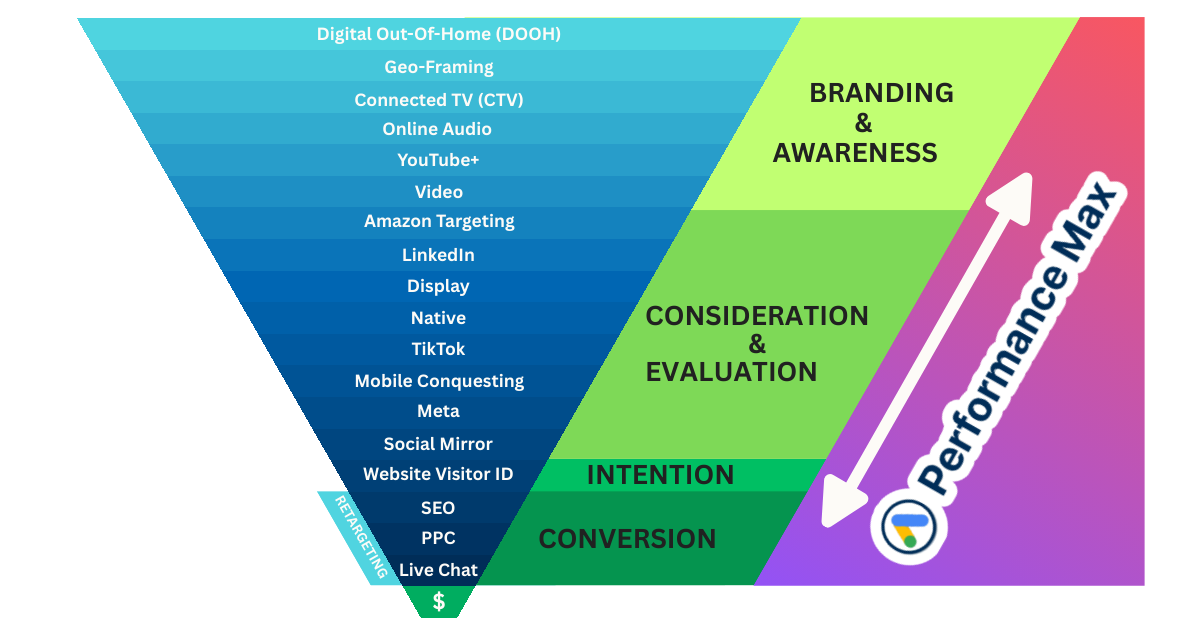
Why would we put this graphic in a presentation deck about tactics, about products? Because it will give you an easy visual to show why you want to recommend certain products (after you’ve done your CNA questions) and it is a commanding form of third-party validation. Clients want to feel good about their choices. They want to feel like they are making smart decisions.
The sales funnel is not a new concept. The digital sales funnel is not a new concept. But! Showing them how their marketing mix fits inside a funnel, often is a very revolutionary light bulb moment for them.
Back to my solar panel example – they weren’t only reaching me through digital ads. The marketing mix I was exposed to included Direct Mail, Meta, Display, SEM/SEO, TV, and CTV (they likely had more, that’s just all I can say reached my household). If you are going to come off as an expert, as a consultant, and not just a seller peddling your biased point of view, it’s important to think about where advertising tactics that are not part of what you sell fit into the journey. In this example it would look like this:

I’ve been using this approach for almost 10 years and can say with full confidence that most clients still don’t know this stuff. It’s not their world. It’s our world. And using it to demystify digital, make it simple, show them how their entire strategy fits together, will make them feel more confident. And that’s what we want. If they feel confident and good about what we are presenting to them, they will buy. And they will stay.
During the CNA, funnels can guide the conversation with a client to help agree on strategy. (Pro tip: reference your CNA meeting checklist while you keep reading (located in adtini > Resources Page > Collateral Tab > Vici Drive > Sample Presentations folder.) Understand WHAT the client is currently doing, and if it’s not something you offer, find the digital equivalent for where that fits in the funnel to try and shift those dollars your way. Understand WHAT their goal or main KPIs are. What are they measuring? Find the products that are going to drive that type of goal or action.
Using the funnel in the CNA can also help identify gaps in their funnel or duplication of effort and dollars. I keep a blank funnel handy in my CNAs and am circling what I hear the client telling me and it creates a powerful visual that tells a story. Usually, you find a gap in one stage or budget is really heavy in one and lacking in another. Showing the client that visual, helps them get it.
Once you have a recommended plan and have done additional research and homework post CNA and have built out a proposal, you can include the funnel to tell their before and after story – what was your prior mix and where was it lacking, and here is your new recommended plan and how I think we can make it better. It’s about showing the client you heard what they said, and applied your knowledge to their business with your pitch.
The funnel can help increase closing ratios in a pitch because the client understands the big picture. It can lead to larger dollars because you're reinforcing the importance of buying multiple products and why it makes sense to not fragment out who is managing those - keep it under one roof so the left hand is talking to the right hand. Customizing the funnel for the client’s marketing plan and what you are recommending can act as a roadmap or game plan long-term and helps manage expectations.
Speaking of expectations, monthly reporting is partially about managing those expectations, showing value and showing we delivered what we promised. Using the funnel in reporting meetings can act as a benchmark for wins and keep the client focused on the original goals and agreed upon outcomes of the campaign and managing expectations if their digital mix isn’t full funnel yet and something they are growing towards.
Not all clients will have a budget that allows for multiple products across all stages of the funnel. That’s OK! We meet them where they are at and grow them into a more robust funnel, but you keep them focused on whatever stage we started them with. If it’s building that branding and awareness, hype of the volume of impressions and the targeting categories for getting the ads in front of the right people. If it’s website traffic, talk about the clicks and how we are comparing the national average benchmark. If it’s conversions, talk about the form fills and what we are measuring and use the funnel to manage expectations if they don’t have a conversion focused product in the campaign. I see it often that 30-60 days into a top-to-mid-funnel campaign clients want to know where their conversions are. Conversions come as a side effect of all advertising, it just can take more time to get people through the funnel if we are only doing higher funnel products, so painting this picture for them helps keep their expectations realistic.
Maybe the most fun use of the funnel is up-selling opportunities! Educating on the value and importance of a full funnel and planting seeds early for a long-term plan to work towards a more robust funnel and paid digital mix. Use the digital sales funnel to upsell and explain where clients can win new opportunities in other or complementary levels of the funnel! If you aren’t saving your original CNA notes, please start!!! 3 months into a campaign, 6 months into a campaign check in on those original notes. How is the plan going against those? Is there room to win back additional dollars that didn’t close initially and use the funnel to reinforce that ask. Gaining trust through consistent customer service for clients leads to more dollars and more dollars leads to a fuller funnel, and eventually getting to that full funnel can create a 1+1=3 situation for the client’s ROI. This makes you as a seller more sticky than other reps as well; the deeper you can get into the client’s media mix and more stages of the funnel that are under your control, the more likely you will be to retain that account long term so using this is a thermometer of sorts to work towards can keep you focused as well.
Now, all of this should be thought of as guidelines. These are not hard, set in stone rules. Some products might not make sense for specific clients even if it’s their goal. And some products can capture other parts of the funnel. And don’t overlook the importance of HOW YOU PICK your behavioral or targeting categories the impact those will have. For example, if you’re doing adults 35+ for your categories that is higher funnel than doing adults 35+ who are in-market for a new mattress, and have a HHI of over $100k/yr.


.png)
